Abstract
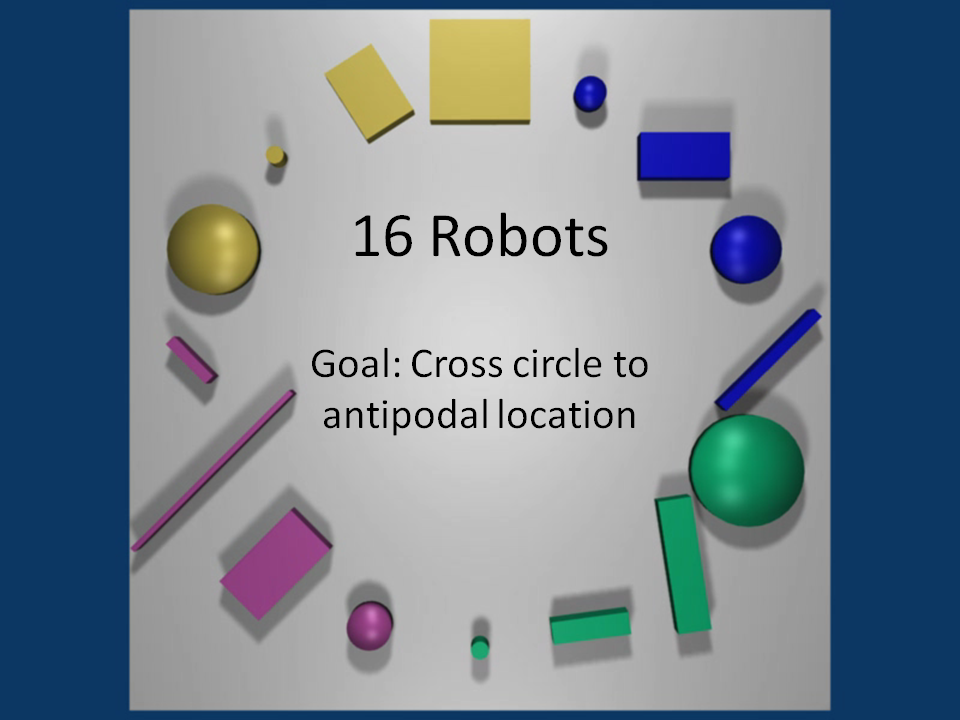
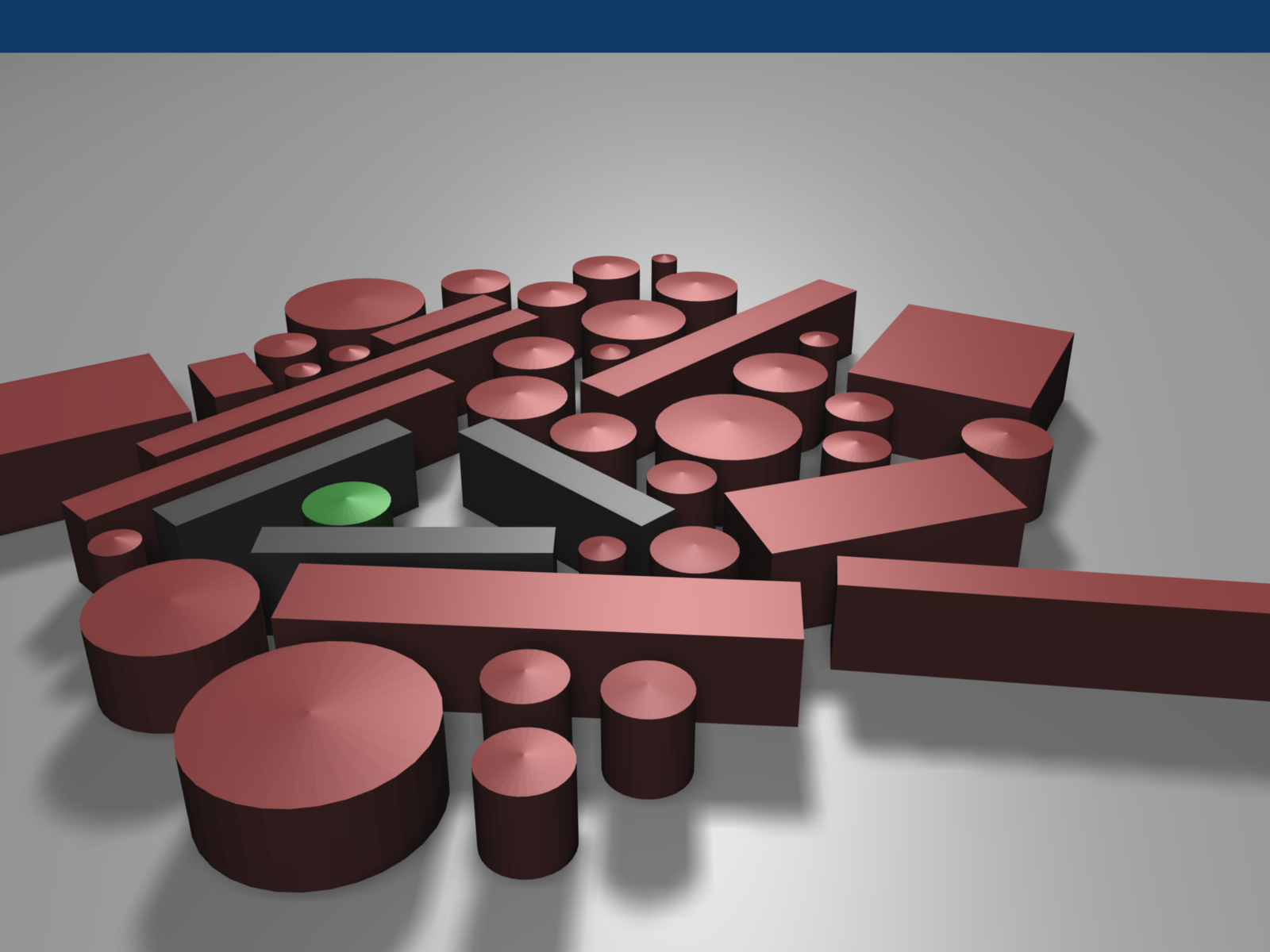
We present a novel approach to compute collision-free paths for multiple robots subject to local coordination
constraints. More specifically, given a set of robots, their initial and final configurations, and possibly some additional coordination constraints, our goal is to compute a collision-free path between the initial and final configuration that maintains the constraints. To solve this problem, our approach generalizes the social potential field method to be applicable to both convex and non-convex polyhedra. Social potential fields are then integrated into a “physics-based motion planning” framework which uses constrained dynamics to solve the motion planning problem. Our approach is able to plan for over 200 robots while averaging about 110 ms per step in a variety of environments.