| Rendering Acceleration Using Incremental Textured Depth Meshes |
| Andy Wilson and Dinesh Manocha |
|
|
| Abstract |
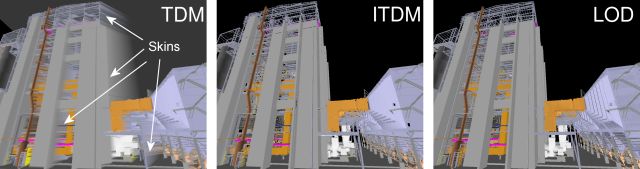
| We present an incremental algorithm to compute image-based simplifications of a large environment. We use an optimization-based approach to generate samples based on scene visibility, and from each viewpoint create textured depth meshes (TDMs) using sampled range panoramas of the environment. The optimization function minimizes artifacts such as skins and cracks in the reconstruction. We also present an encoding scheme for multiple TDMs that exploits spatial coherence among different viewpoints. The resulting simplifications, incremental textured depth meshes (ITDMs), reduce preprocessing, storage, rendering costs and visible artifacts. Our algorithm has been applied to large, complex synthetic environments comprising millions of primitives. It is able to render them at 20-40 frames per second on a PC with little loss in visual fidelity. |
The paper is available as a SIGGRAPH 2003 paper (PDF, 2.9 MB). The work described therein is part of Andy Wilson's dissertation (PDF, 8.5 MB).
| Videos | |

|
Incremental TDMs in the house environment (QuickTime Movie, 37 MB) |
|
Incremental TDMs vs. static levels of detail (QuickTime Movie, 111 MB) |
|
Incremental TDMs vs. standard TDMS (frame rate comparison) (QuickTime Movie, 59 MB) |
|
Incremental TDMs vs. standard TDMS (quality comparison) (QuickTime Movie, 131 MB) |
|
Copyright © 2003 University of North Carolina at Chapel Hill. Personal use of this material is permitted. However, permission to reprint/republish this material for advertising or promotional purposes or for creating new collective works for resale or redistribution to servers or lists, or to reuse any copyrighted component of this work in other works must be obtained from the author. This material is presented to ensure timely dissemination of scholarly and technical work. Copyright and all rights therein are retained by authors or by other copyright holders. All persons copying this information are expected to adhere to the terms and constraints invoked by each author's copyright. In most cases, these works may not be reposted without the explicit permission of the copyright holder. Last modified: Fri Mar 14 22:09:34 EST 2003. |