


to COMP 205 Homework 3--- Solutions to algebraic proofs
Problems
NOTE: there is no single correct proof for any of these problems; many approaches are possible, and solutions will be graded on correctness and clarity of reasoning and presentation.
 vector
  , show that

and

(a) 
Since norms are always positive, we can equivalently prove
 .
Now,
.
Now,
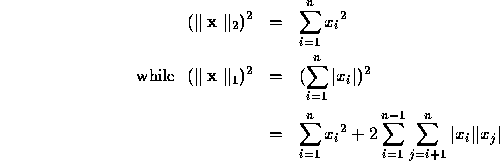
and because the multiple summation term is  , our proof is complete.
(b)  . Several different proofs
of this were possible. Typically we could
square both terms as before, then use the above formula and the theorem
. Several different proofs
of this were possible. Typically we could
square both terms as before, then use the above formula and the theorem
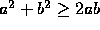 (since
  ), to get
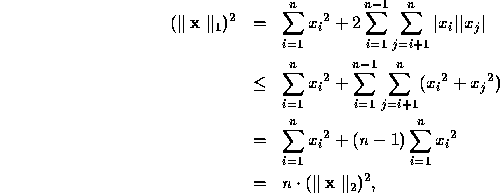
thus demonstrating the desired inequality. As an alternate proof, one might use the
Cauchy-Schwarz inequality  and let y be the vector

The left-hand side is simply  and the right hand side is
  , and our desired inequality is thus shown.
(c)  . Again we'll square both sides.
Let
. Again we'll square both sides.
Let  . Then, clearly,

completing our proof.
(d)  Squaring both sides, and letting
  as above,
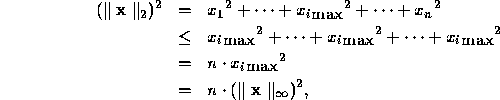
completing our proof.
(e)  . Fairly trivial,

(f)  . Similar to (d),

It also follows simply from  and
and  , as proven above.
 and
and  , let
, let  be operator norms, as defined in the class. Prove the following properties :
 ,
if
,
if  is the operator norm induced by the vector norm
  .
.
 .
.
 .
.
 .
.
(a)  . By definition of operator norm,

Therefore,  .
(If
.
(If  , trivially true.)
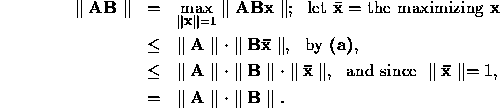
(b)  . This follows most simply from the
previous result:
. This follows most simply from the
previous result:
and therefore  .
.
(c)  .
This problem gave folks a lot of trouble. The most straightforward proofs first established
the max. column-sum as an upper bound, then showed that it was indeed achieved.
.
This problem gave folks a lot of trouble. The most straightforward proofs first established
the max. column-sum as an upper bound, then showed that it was indeed achieved.
From the definition,  .
Then,
.
Then,  .
Now,
.
Now,

Let column k be the column of  with the maximum absolute column sum, i.e.

Then

thus giving our upper bound  .
.
This bound is achieved if we let  be a vector such that
  and
and  for all
  . Then

and therefore  .
.
(d)  . (The last
equality follows trivially, since the max abs row sum of
. (The last
equality follows trivially, since the max abs row sum of  = max abs column sum
of
= max abs column sum
of 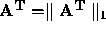 , as shown in (c).) We'll proceed similarly as above,
establishing the upper bound, then showing a vector that achieves it.
, as shown in (c).) We'll proceed similarly as above,
establishing the upper bound, then showing a vector that achieves it.
From the definition, 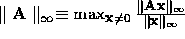 .
Then,
.
Then,  .
Now,
.
Now,

Therefore, we have the upper bound

We now show that this bound is achieved. Let k be the row with the maximum abs row-sum, i.e.

Then we create the vector x such that

and note that  . Then,

Since we've already established this as an upper bound, the equality is
proven, and thus,  .
.